Aluminum Cladding

The finish on an aluminum facade is often selected late in design development, after geometry, orientation, and system depth are established. Yet it remains directly exposed to UV radiation, moisture, airborne contaminants, and cleaning procedures throughout the building’s service life.
That makes finish selection more than a color decision. It is a performance specification affecting appearance retention, maintenance planning, replacement risk, and the long-term consistency of the building envelope. The project team must determine whether the complete finishing system (pretreatment, coating, application, curing, and quality control) is suitable for the building’s exposure and expected lifecycle.
aPlank approaches finish selection as part of the overall extruded aluminum cladding system specification. Its prefinished aluminum panels and battens are available in solid colors, woodgrain patterns, metallic appearances, and material-inspired finishes, coordinated with documented exterior-performance requirements.
Finish Selection Begins with Exposure
Two buildings may use similar aluminum profiles but place very different demands on their finishes.
A protected soffit beneath a deep canopy does not experience the same UV exposure, wind-driven rain, salt deposition, or cleaning cycles as a high-rise facade near the coast. An institutional entrance at pedestrian level may also require different resistance to abrasion and repeated cleaning than panels installed several stories above grade.
Before choosing a coating standard or finish family, the project team should evaluate:
- Geographic location and climate
- Coastal, industrial, or high-UV exposure
- Vertical facade, soffit, screen, or interior application
- Expected cleaning access and frequency
- Color intensity and sensitivity to visible fading
- Project warranty and service-life expectations
- Adjacency to dissimilar metals, sealants, and cleaning products
The finish should be specified in relation to the application, not treated as a universal layer that performs identically in every condition.
This is especially important when matching the finish across different aPlank products. Extruded aluminum cladding panels, battens, trims, and custom profiles may have different geometries and orientations, but the visible surfaces still need to read as a coordinated architectural composition.

Review Color and Finish Options
Explore aPlank's solid colors, metallic finishes, and woodgrain options that complement your design and meet the project’s exposure requirements.
Request finish samples →Coating Standards Establish Measurable Expectations
Architectural coating specifications provide a common performance framework for manufacturers, finishers, architects, and contractors. Rather than relying on broad language such as “exterior-grade coating,” recognized standards identify testing and performance requirements associated with weathering, adhesion, corrosion resistance, color retention, chalking, and other properties.
FGIA’s AAMA 2603, AAMA 2604, and AAMA 2605 documents cover progressively higher-performing organic coatings applied to aluminum extrusions and panels. FGIA classifies AAMA 2605 as its specification for superior-performing organic coatings, while AAMA 2604 addresses high-performance coatings and AAMA 2603 establishes requirements for pigmented organic coatings. Review the current FGIA coating specification listings.
The designation is important, but it should not be used as shorthand for every aspect of the finish. A standard defines performance requirements; it does not replace confirmation of the selected color, gloss, texture, resin system, substrate preparation, applicator capabilities, or project-specific warranty.
A detailed comparison of AAMA 2605 vs. 2604 vs. 2603 coating standards is therefore most useful when tied to actual exposure and service-life expectations. Specifying the highest tier without reviewing the application may add unnecessary cost in some locations. Using a lower tier on a highly exposed commercial facade, however, can create a mismatch between initial savings and long-term appearance requirements.
aPlank exterior finish options can be coordinated with AAMA 2605-level performance requirements where the project demands high resistance to exterior weathering. The applicable finish documentation should be reviewed as part of the submittal rather than inferred from a color name or marketing sample.
Coating Chemistry and Performance Are Related, but Not Identical
Project specifications sometimes use coating chemistry and performance classification interchangeably. They answer different questions. The PVDF versus polyester coating comparison for aluminum facades concerns resin chemistry, formulation, and expected weathering behavior. The AAMA classification concerns whether the finished system satisfies defined performance requirements. A specification should identify both when necessary, and clarify whether the finish is factory-applied to extrusions, coil-coated, or produced through another controlled method.
Factory finishing allows preparation, application, and curing to occur under controlled conditions before panels reach the site, supporting more consistent coverage than field painting. It does not eliminate the need for care, however. Finished aluminum must be handled carefully through fabrication, packaging, transportation, and installation. Scratches, incompatible protective films, sealant residue, and aggressive cleaning can affect an otherwise compliant coating.
Decorative Finishes Must Still Be Performance Specifications
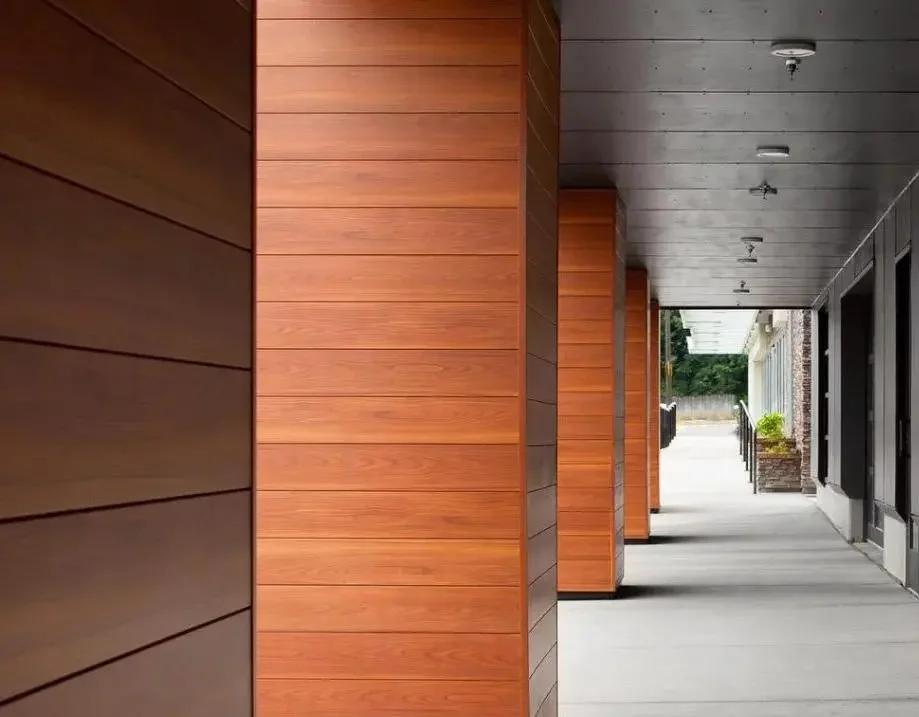
Designers increasingly use woodgrain, concrete, stone, metallic, or textured appearances to create material depth without the maintenance demands of natural materials. For aPlank, this range is relevant because extruded profiles span rainscreen cladding, soffits, battens, screens, and feature areas, each retaining a coherent visual language while retaining the dimensional stability and non-combustible aluminum substrate.
Woodgrain and custom finishes for aluminum panels should be reviewed with the same discipline as conventional solid colors. Project teams should confirm:
- Whether the finish is rated for exterior use
- The applicable performance standard
- Pattern repeat and directional requirements
- Variation between production runs
- Acceptable gloss and texture range
- Touch-up limitations
- Replacement-panel matching expectations
- Warranty coverage for color and finish integrity
Large-format samples or mockups are particularly valuable for patterned finishes. A small chip communicates color but cannot show pattern scale, repetition, directional changes, joint alignment, or the effect of sunlight across a full elevation.

Architectural aluminum finish samples showing the decorative and weathering-performance options available for extruded aluminum cladding profiles, including finishes rated to AAMA 2605 for long-term exterior exposure.
Color Decisions Affect More Than Appearance
Color selection can influence heat absorption, visible weathering, perceived panel flatness, and the way joints or profile transitions appear under changing light.
A structured custom color aluminum cladding process should therefore move beyond selecting a digital reference or printed color value. It may include physical color standards, approved samples, defined gloss ranges, production-size samples, and project mockups.
aPlank offers standard and custom finish options across its extruded aluminum panels and battens, allowing the finish to be coordinated with profile depth, module, orientation, and surrounding materials. Early consultation is especially useful when a project requires a custom match or when several product profiles must maintain visual consistency across different facade conditions.
Durability Is a System Outcome
Coating performance contributes to longevity, but the service life of aluminum cladding cannot be assigned to the finish alone.
The lifecycle cost and durability of aluminum cladding depend on the complete facade system. Aluminum’s inherent corrosion resistance provides a strong substrate for architectural use, while commonly used architectural extrusion alloys offer a practical balance of formability, strength, surface quality, and corrosion resistance.
| Performance factor | Why it matters |
|---|---|
| Profile and drainage design | Helps manage moisture and limits conditions that can trap contaminants. |
| Coating and pretreatment | Supports corrosion resistance, adhesion, and long-term appearance retention. |
| Installation quality | Reduces handling damage, poor alignment, and localized performance issues. |
| Material compatibility | Helps prevent galvanic interaction and chemical incompatibility with adjacent materials. |
| Cleaning and maintenance | Limits contaminant buildup and helps preserve the finish condition. |
| Replacement strategy | Supports future panel, color, and finish matching when localized replacement is required. |
The coating adds another controlled layer of protection and appearance management. When substrate, pretreatment, finish, fabrication, and installation are properly coordinated, the facade can retain its intended expression with limited intervention. Exposure, detailing, finish quality, and local conditions all affect actual service life.
Maintenance Should Be Defined During Specification
Low-maintenance does not mean no maintenance. Even durable factory coatings require periodic inspection and cleaning to remove contaminants and catch localized issues early. An aluminum facade panel maintenance plan should address cleaning frequency, approved products, access requirements, repair procedures, joint inspection, and documentation needed to preserve applicable warranties.
Maintenance planning also affects finish selection. Coastal and industrial environments accumulate salts and pollutants faster, especially in sheltered areas. A surface that is difficult to access or repeatedly cleaned may require different finish considerations than an upper-level panel exposed mainly to weather.
Sustainability Claims Require Project-Specific Documentation
Finish durability supports sustainability by extending replacement cycles. Coating-performance standards such as AAMA 2604 and AAMA 2605 document weathering resistance, color retention, chalk resistance, and adhesion: durability metrics that are an important part of lifecycle evaluation, even though they are not environmental certifications.
Sustainable coatings for aluminum facades should not be evaluated through a single attribute. Relevant considerations include coating composition, emissions controls at the finishing facility, material disclosures, expected service life, repairability, recyclability of the aluminum substrate, and effects on end-of-life processing.
VOC requirements vary by coating category, application method, and jurisdiction. The U.S. EPA establishes national VOC requirements for architectural coatings, while state and regional agencies may impose additional limits. Project teams should distinguish between regulations for field-applied coatings and the controlled factory-finishing processes used for prefinished aluminum products.
Specifying the Finish as Part of the Facade System
A resilient aluminum facade begins with a finish specification that connects visual intent to measurable performance. Project documents should identify the substrate, finish type, required performance standard, approved colors, gloss or texture, exposed surfaces, sample requirements, applicator qualifications, touch-up limitations, protection procedures, warranty expectations, and maintenance requirements, coordinated across panels, battens, trims, corners, and custom profiles.
aPlank provides prefinished extruded aluminum cladding options that allow architects to combine solid colors, woodgrain patterns, metallic appearances, and material-inspired finishes with project-specific profiles, treating finish decisions as part of the engineered facade scope. The result is a finish strategy developed to remain appropriate for the building, its exposure, and its expected lifecycle.
Aluminum Cladding Coating Standards: Common Questions
Which AAMA coating standard is appropriate for exterior aluminum cladding?
The appropriate standard depends on exposure, service-life expectations, color sensitivity, maintenance access, and project warranty requirements. AAMA 2605 is commonly specified for highly exposed commercial facades requiring superior long-term color and chalk resistance, while AAMA 2604 or 2603 may be appropriate for less demanding applications.
Is PVDF the same as AAMA 2605?
No. PVDF identifies a resin chemistry, while AAMA 2605 defines performance requirements for a complete factory-applied coating system. A compliant specification should identify the required performance standard and confirm that the selected coating system, pretreatment, applicator, and color are covered by the submitted documentation.
Can woodgrain aluminum finishes be specified for exterior facades?
Yes, provided the selected finish is documented for exterior use and the project team confirms its applicable performance standard, pattern direction, repeat, production-lot variation, warranty, and replacement-panel matching expectations. Large-format samples or mockups are recommended because small chips cannot communicate pattern scale or directional effects.
What should be included in an aluminum facade finish specification?
The specification should identify the aluminum substrate, finish type, required coating standard, approved color and gloss range, exposed surfaces, sample and mockup requirements, applicator qualifications, protection procedures, touch-up limitations, warranty expectations, and maintenance requirements.