Rainscreen Facade Systems for Commercial Buildings: Engineering, Performance & Specification
 Rainscreen · Specification Guide

A rainscreen facade system is one of the most consequential decisions made during the design of a commercial building envelope. When it performs as designed, moisture is managed, thermal performance is maintained, and the cladding holds its finish for decades. When the system is assembled from mismatched components without tested documentation, the risks materialize slowly: water infiltration behind the cladding, insulation degradation, failed inspections and code review delays, and costly remediation. The difference between these two outcomes is rarely the cladding panel itself. It is the assembly, the specification rigor, and whether the supplier delivers a tested, complete system or a collection of parts. Understanding that distinction is what separates a confident specification from a costly one. Specifiers and architects must evaluate their options from a position of full technical understanding, this technical overview covers every layer of a commercial rainscreen assembly, from cavity design principles to subframing integration, code compliance requirements, and material selection. aPlank engineers extruded aluminum cladding panels and thermally broken aluminum subframing as integrated, tested assemblies designed for exactly this standard of specification.
What Is a Rainscreen Facade System?
A rainscreen facade system is a two-stage weather-resistive assembly. The outer cladding layer manages the primary weather load while a ventilated air cavity behind it handles any moisture that penetrates the panel joints. The cavity is the system's defining feature: it is what separates a rainscreen vs. barrier wall facade in both principle and long-term performance, and it is what gives the assembly its durability advantage over face-sealed systems.
The Pressure-Equalized Principle
High-performance rainscreen assemblies are designed around pressure equalization: the air pressure within the cavity is brought into near-equilibrium with the exterior, removing the driving force that pushes water inward through gaps and joints. When pressure differential is minimized, the need for fully sealed panel joints disappears, allowing open or baffled joints that drain freely rather than trapping moisture at the face of the cladding. Effective rainscreen moisture control depends on this equilibrium being maintained across the full height of the assembly, not just at individual panel joints.
Why Ventilated Cavity Design Matters
The ventilated cavity does three things simultaneously: it drains any moisture that enters, it allows the assembly to dry by promoting airflow behind the panels, and it decouples the thermal mass of the cladding from the primary structure. This separation reduces the thermal stress cycling that causes adhesive and sealant failures in face-sealed systems, and it keeps the air barrier protected from both weather exposure and temperature extremes. aPlank engineers every assembly component (panel, subframe, and air barrier interface) to work together as a single tested system, so the cavity performs as designed from day one of installation.

From Panel to Subframe: See How a Complete Rainscreen Assembly Comes Together
aPlank delivers rainscreen assemblies engineered as a single tested system: extruded aluminum panels, the aFrame thermally broken subframe, and full submittal documentation. Every component specified to perform together.
Start Your Specification →How the Ventilated Cavity Works
The ventilated cavity is engineered space. Its depth, continuity, and termination details determine whether the system drains and dries effectively or traps moisture at horizontal ledges and inside corners. Ventilated cavity facade design practice defines the parameters that make the difference, from minimum air gap dimensions to flashing geometry at floor lines and window heads.
Drainage, Drying, and Air Circulation
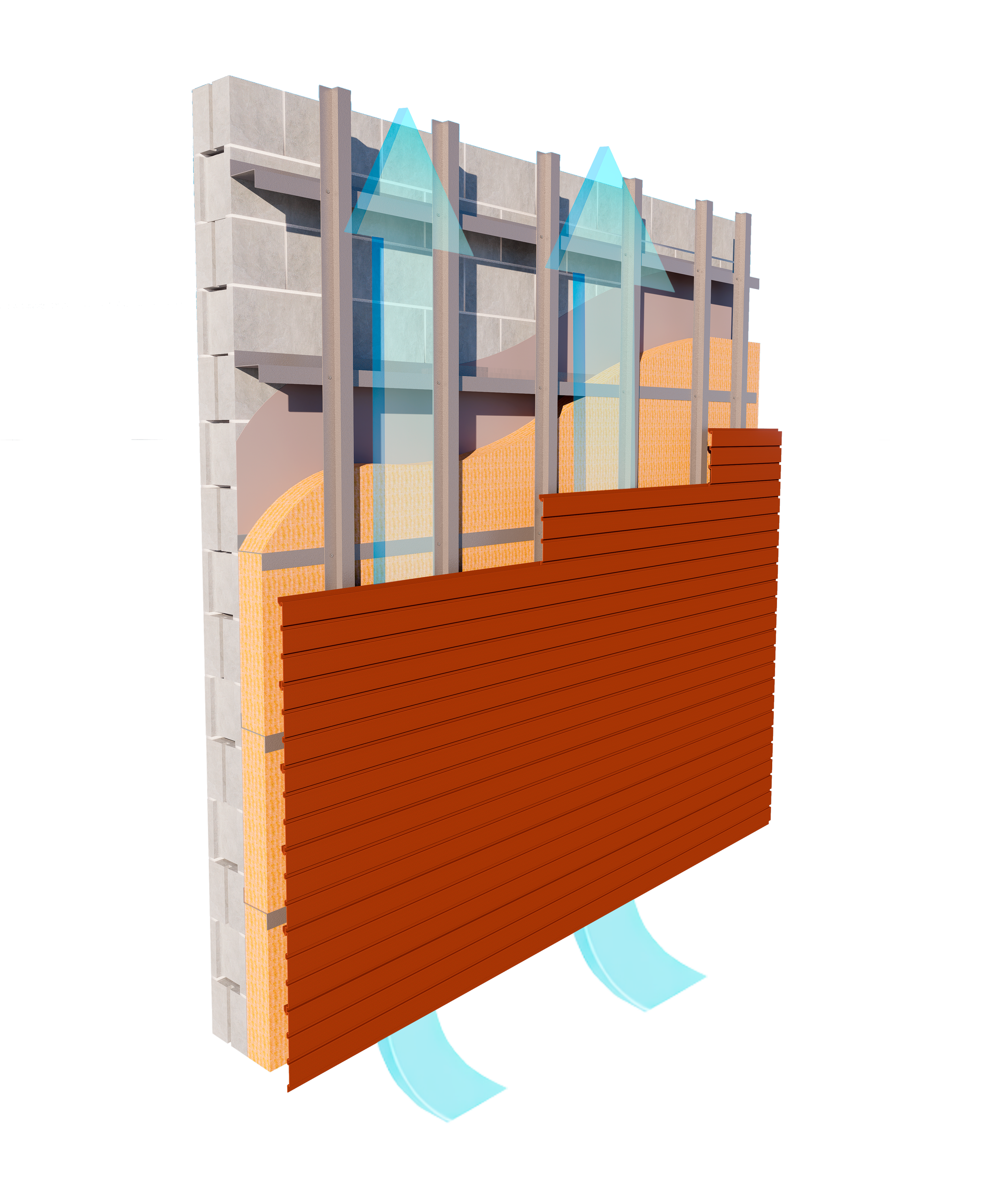
Air enters the cavity at the base, rises as it warms, and exits at the top, creating a continuous convective loop that removes moisture-laden air from behind the panels. Horizontal flashing at floor lines and window heads must be sloped to shed water to the exterior, and weep holes at the base of the cavity must remain unobstructed. Insulation installed within the cavity rather than in a continuous exterior layer outside it will interrupt airflow and undermine drying capacity; this is a common field error on projects where the cavity design is not carefully carried through the details.
Cavity Dimensions and Best Practices
Industry guidance establishes a minimum cavity depth of 3/4 inch (19 mm) for effective drainage and drying in most climates. In high-exposure environments, wind-driven rain zones, or assemblies incorporating continuous exterior insulation, a 1.5 to 2-inch cavity is preferable. Aluminum rainscreen panel installation on commercial projects requires the cavity depth to be confirmed against climate zone, building height, exposure category, and insulation thickness before subframe layout begins; it is a design calculation, not a default.
System Components: Panel, Subframe, and Air Barrier
A complete rainscreen assembly is four layers working in sequence. Each layer has a defined function, and the performance of the whole depends on the integrity of every interface. Sourcing these components from a single engineered system eliminates the coordination gaps that create problems at the submittal stage and in the field.

A complete rainscreen facade assembly: structural substrate, continuous insulation layer, thermally broken subframing establishing the ventilated cavity, and extruded aluminum cladding panels at the face.
Extruded Aluminum Panels as the Cladding Layer
The cladding panel is the assembly's weather face and its aesthetic expression. Extruded aluminum is the material of choice for commercial rainscreen applications because it combines non-combustibility, dimensional stability, and finish longevity in a single component. Unlike composite panels or fiber cement, extruded aluminum does not retain moisture, does not require periodic repainting, and can be formed to virtually any geometry without the tooling cost barriers that once limited design flexibility. aPlank's extruded aluminum cladding panels are available across flat, ribbed, corrugated, and custom extrusion profiles, with finish options spanning AAMA 2605-compliant fluoropolymer coatings, anodizing, and woodgrain finishes.
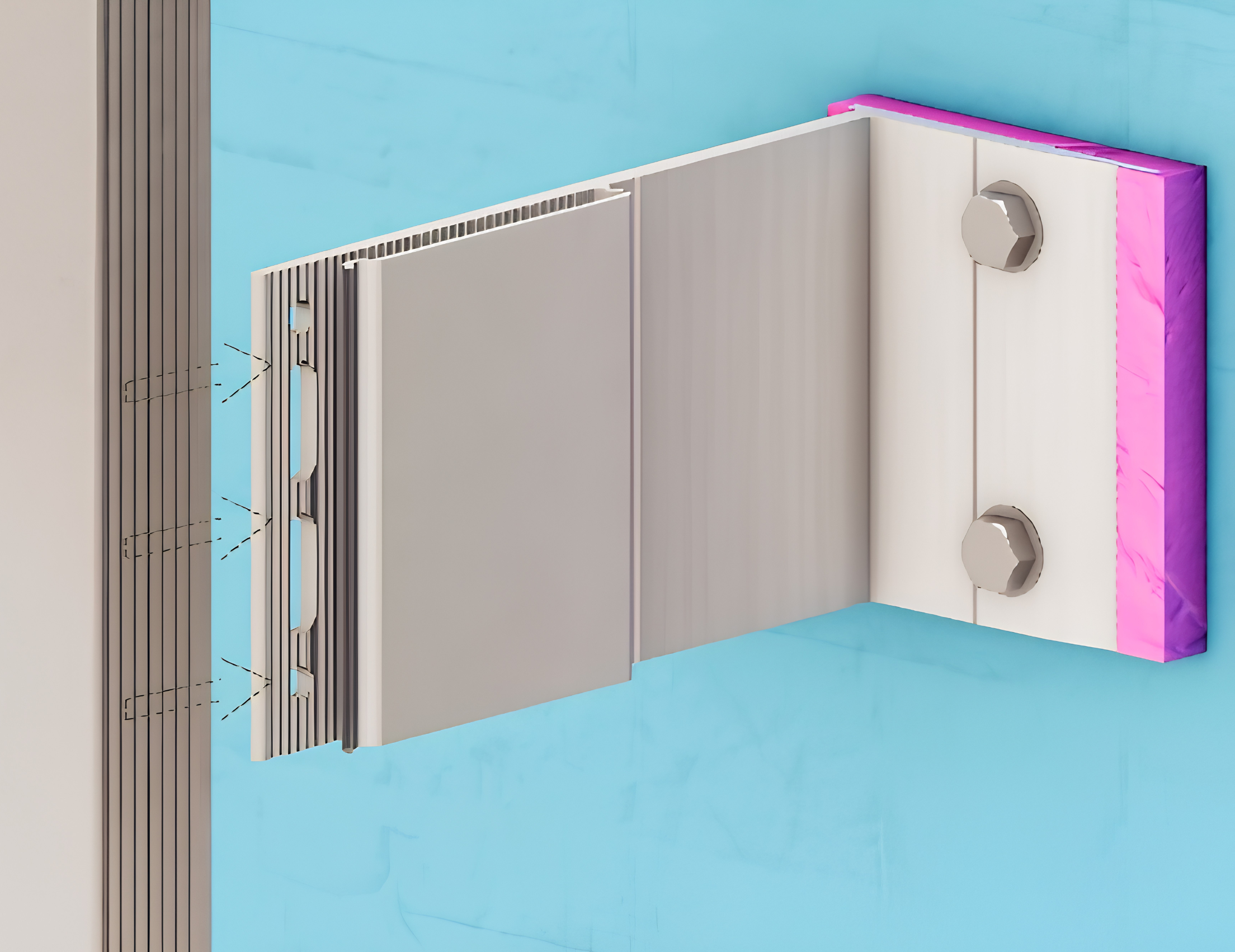
Thermally Broken Subframing and aFrame Integration
The subframing system does more than hold the panels. It establishes cavity depth, transfers wind load back to the structure, and, in a thermally broken subframe rainscreen configuration, prevents conductive heat transfer through the metal brackets that would otherwise create direct thermal paths across the insulation layer. Thermal bridging through facade subframing without thermal breaks can significantly undermine the effective R-value of the continuous insulation layer at every bracket location, a cumulative loss that compromises the thermal performance of the entire assembly. The aFrame subframing system, uses structural thermal breaks at every bracket point, preserving the continuous insulation layer's full R-value while maintaining the structural performance required for commercial wind load conditions.
Air Barrier Selection and Continuity
The air and water-resistive barrier is the assembly's last line of defense. Its performance depends not on the material alone but on the continuity of the installation: every penetration, termination, and transition must be detailed to maintain an unbroken plane. Fluid-applied membranes are increasingly preferred in commercial rainscreen applications because they eliminate the laps and seams that are the most common failure points in sheet-applied systems.
“Pre-engineering facade details is where design intent is either protected or lost. The difference between a tested assembly and a field-built one is a project-level risk.”
— aPlank, Building Envelope Specification GuidanceCode Compliance: What Commercial Projects Must Meet
Rainscreen facade systems on commercial buildings operate within a defined regulatory framework. The specific tests and standards that apply depend on building type, height, the presence of combustible components in the assembly, and the jurisdiction. Understanding which standards are triggered, and which documentation is required to demonstrate compliance, is a prerequisite to system selection, not an afterthought.
NFPA 285 and Non-Combustible Assembly Requirements
Under the International Building Code, buildings of Type I, II, III, or IV construction that incorporate foam plastic insulation or other combustible components in an exterior wall assembly must demonstrate compliance with NFPA 285 through a full-scale fire propagation test that evaluates the complete assembly, not the individual components. Material selection alone does not establish compliance; the tested assembly configuration, including the specific panel, air barrier, insulation, and subframing, must match the configuration used in the actual test. Non-combustible extruded aluminum panels offer a reliable compliance pathway because aluminum does not contribute to flame spread, simplifying the test configuration and reducing the number of variables that can generate compliance gaps.
ASTM E84, ASTM E136, and IBC Chapter 14 Overview
The ASTM E84 surface burning characteristics test measures flame spread index and smoke development for building materials. For cladding panels, a Class A rating (flame spread index 0–25) is required for most commercial applications under IBC Chapter 14, which governs exterior wall coverings. Aluminum panels consistently achieve Class A ratings due to the material's non-combustibility. Compliance documentation for ASTM E84 and NFPA 285 should be requested from the supplier as part of the specification submittal; assemblies without this documentation introduce risk at the building department review and inspection stages. Projects in Florida carry an additional layer of jurisdiction-specific review: Miami-Dade approved rainscreen systems must meet high-velocity hurricane zone impact and wind-driven rain requirements that go beyond the baseline IBC compliance package.
Why Aluminum Outperforms Alternative Cladding Materials
The cladding material selection for a commercial rainscreen involves tradeoffs across fire performance, lifecycle cost, design flexibility, and maintenance burden. The comparison below evaluates extruded aluminum against the two most common alternatives in the U.S. commercial market.
Extruded Aluminum
- Non-combustible; Class A ASTM E84; does not contribute to NFPA 285 fire propagation
- AAMA 2605: 10+ year color retention; no repainting required
- Extruded to custom geometry; no die-cost premium for repeat orders
- Lightweight; reduces subframe load and structural demand
- Low maintenance; fully recyclable at end of service life
Fiber Cement
- Non-combustible substrate; finish layer may require separate fire testing
- Painted finish; requires repainting every 8–12 years
- Limited to flat panels; profiling adds cost and lead time
- Heavier than aluminum; increases subframe and structural load
- Higher maintenance burden; not recyclable
ACM (Aluminum Composite)
- Core-dependent fire risk; PE core fails NFPA 285; FR core required
- PVDF coating available; thinner substrate limits long-term durability
- Flat panels standard; limited to bent or folded profiles only
- Lightweight; similar weight profile to extruded aluminum
- Core delamination risk over time; periodic inspection recommended
Finish Standards and Long-Term Performance
Finish selection for aluminum cladding panels is governed by AAMA coating performance standards, which define three tiers of fluoropolymer coating durability: AAMA 2603 (polyester), AAMA 2604 (70% PVDF), and AAMA 2605 (70% PVDF with enhanced performance requirements including a 10-year minimum chalk and fade resistance). For commercial facade applications where maintenance access is limited and panel replacement is costly, AAMA 2605 is the specification that aligns with the project's lifecycle cost interests. The performance gap between 2604 and 2605 becomes most apparent in high-UV environments, coastal locations, and on south and west-facing facades where solar exposure is continuous. Aluminum cladding finishes and woodgrain options are available across aPlank's standard palette and custom color matching program.

aPlank extruded aluminum panel samples across profile and finish options.
Choosing an Engineered Rainscreen Supplier
The distinction between a cladding vendor and an engineered rainscreen supplier is significant at the specification stage and becomes critical during submittals, RFIs, and installation. A vendor supplies panels. An engineered supplier delivers a tested, documented assembly and the technical support to carry it through the project lifecycle, whether the project is a single-story retail strip, a mid-rise multifamily building, or a high-rise institutional facade.
Documentation, Testing, and Submittal Readiness
A qualified rainscreen supplier should be able to provide, at minimum: ASTM E84 surface burning test reports, ASTM E136 non-combustibility certification, ASTM E330 structural performance data, AAMA coating certification for the specified finish, and structural engineering for the subframe bracket layout. For projects in hurricane exposure zones, TAS 202 impact testing and TAS 203 cyclic pressure documentation are also required. NFPA 285 compliance operates at the assembly level: it is determined by the full wall assembly configuration, including insulation and air barrier, and is not a panel supplier deliverable. Requesting this documentation early in the specification process reveals quickly whether a supplier is genuinely engineered or is assembling components from third-party sources without full-system test coverage. The requirements are consistent across project types, whether the scope is a single-story commercial facade or aluminum rainscreen multifamily buildings where Type III construction triggers the full IBC assembly compliance stack. For project teams managing tight schedules, prefabricated rainscreen facade systems offer a path to faster enclosure by delivering factory-assembled, pre-documented panels that arrive on site ready for installation.
The Specification Sequence for a Compliant Assembly
Structural Wall & Continuous Insulation
The substrate and insulation layer are specified first. Continuous exterior insulation thickness is determined by energy code requirements (IECC climate zone) and thermal bridging calculations for the chosen subframe system.
Air & Water-Resistive Barrier
The WRB is applied over the insulation or substrate with full continuity at penetrations, transitions, and terminations. Fluid-applied membranes are preferred for complex geometries; compatibility with the insulation substrate must be confirmed.
Thermally Broken Subframing
The subframe establishes cavity depth and transfers structural loads. Thermal breaks at every bracket point preserve the continuous insulation's full R-value. Bracket sizing is determined by panel weight, wind load, and floor-to-floor height.
Extruded Aluminum Cladding Panels
Panels are installed over the subframe with open or baffled joints that allow cavity ventilation. Profile, finish, and attachment method are confirmed against the tested assembly configuration. Exterior aluminum battens may be integrated for screening or accent applications.
Flashing, Terminations & Inspection
Horizontal flashing at base, head, and floor transitions is installed and inspected before panels close the cavity. Weep holes at the base are confirmed unobstructed. Final submittal documentation is assembled against the installed configuration for the project record.
aPlank supplies full submittal packages for every project, including tested assembly drawings, structural engineering for the aFrame subframe layout, and NFPA 285 and ASTM E84 compliance documentation. The complete specification package is available through the aPlank downloads page or on request from the project team.
Specifying with Confidence
A well-specified rainscreen facade system comes down to three things: a ventilated cavity designed with correct depth and proper termination details; an integrated assembly where the panel, subframing, and air barrier are specified and tested together; and compliance documentation that covers the full assembly configuration. When these three conditions are met, the system performs as designed for the life of the building.
For commercial projects where the margin for error is low and the cost of remediation is high, the supplier selection is as consequential as the material selection. aPlank delivers complete rainscreen assemblies: extruded aluminum cladding panels, the aFrame thermally broken subframe, and full submittal documentation, all engineered as a single tested system. Review the technical specifications or bring your project to the team to begin the specification process.
Rainscreen Facade Systems: Common Questions
What is the difference between a rainscreen and a traditional cladding system?
A traditional cladding system applies the weather-resistive layer directly to the wall substrate, leaving little room for moisture drainage or drying. A rainscreen system introduces a ventilated air cavity between the cladding panel and the air barrier, allowing any moisture that penetrates the outer layer to drain and evaporate before it reaches the structure. This drainage plane protects the air barrier, extends the life of the assembly, and significantly reduces the risk of water damage and long-term structural deterioration.
What cavity depth is recommended for a commercial rainscreen facade?
Industry guidance establishes a minimum cavity depth of 3/4 inch (19 mm) for effective drainage and drying in most commercial applications. In high-exposure climates, wind-driven rain environments, or assemblies incorporating continuous exterior insulation, a cavity of 1.5 to 2 inches is preferable. The correct depth is a design calculation based on climate zone, building height, exposure category, and insulation thickness; it is not a fixed default that applies across all projects.
Does a rainscreen facade system need to comply with NFPA 285?
Yes, in most commercial applications. Under the IBC, buildings of Type I, II, III, or IV construction that incorporate foam plastic insulation or other combustible components in an exterior wall assembly must demonstrate compliance with NFPA 285. The test evaluates the complete assembly, not individual components, so the tested configuration must match the specified one. Non-combustible extruded aluminum panels simplify compliance by removing a key variable from the test assembly.
What components make up a complete rainscreen facade assembly?
A complete rainscreen facade assembly consists of four primary layers: the structural wall or substrate; a continuous air and water-resistive barrier; a thermally broken subframing system that creates and maintains the ventilated cavity; and the exterior cladding panels. Ancillary components include flashing at horizontal terminations, weep holes at the base of the cavity, and the finish coating applied to the panels. Each layer performs a specific function; overall performance depends on the integrity of every component and the continuity of the interfaces between them.